
When you’re building something new, nobody tells you whether you’re early or simply wrong. I’ve been both.
I’ve spent more than twenty-five years designing and building technology, and the longer I do it, the less interested I become in predicting what comes next. Experience has taught me how difficult it is to distinguish between an idea that other people haven’t recognized yet and one that simply isn’t very good.
I’ve created products I was convinced people would understand that they didn’t. I’ve pursued ideas I believed were ahead of their time that went nowhere. I’ve also built technologies that once required twenty minutes of explanation become so ordinary that nobody remembers questioning them.
When you live through enough of those cycles, something changes. You become more comfortable with uncertainty, and you begin to notice things you might once have overlooked. Not because you’re necessarily smarter or more imaginative. You’ve just been looking longer.
I remember the Magic Eye posters that became popular in the 1990s. At first glance they looked like fields of repeating colors and patterns, almost like visual noise. But somewhere inside was a three-dimensional image.

Some people saw it immediately. Others stared for several minutes before the picture suddenly appeared. Some never saw it at all.
Nothing about the poster changed. Every pixel required to see the image had been there from the beginning.
The pixels didn’t change. The observer did.
I suspect experience works much the same way. When you spend years building things, you accumulate more than knowledge. You accumulate context. You begin recognizing relationships between things that once seemed unrelated. You notice friction that someone encountering a product for the first time might miss. You become suspicious of certain assumptions because you’ve watched them fail before.
If you’re paying attention, you also develop an instinct for questioning your own certainty. Experience does not automatically make you right.
Sometimes you stare at the pixels for years and realize there really is no picture.
This is what gets lost in the mythology we build around people who supposedly saw the future before everyone else. We tell their stories backwards, after history has already decided which ideas mattered. The failed experiments, bad assumptions and strongly held beliefs that went nowhere gradually disappear from the story.
What remains is a clean narrative about someone who saw something nobody else could see.
Anyone who has ever tried to construct something new knows that building never feels that clean from the inside. You are constantly trying to determine whether a pattern is actually emerging or whether you simply want badly enough for one to be there.
That process has shaped the way I think about artificial intelligence.
We are living through a period of extraordinary technological change, and everyone seems to have an opinion about what AI will become. Some see a productivity tool or a better search engine. Others see automation, job displacement, an investment bubble or an entirely new computing platform.
I don’t think any of us can see the entire picture yet.
After spending the last several years actually building with AI, however, I am increasingly convinced that one of its most consequential effects may have less to do with what machines know than with what access to that knowledge does to us.
For most of human history, knowledge was difficult to acquire. Becoming genuinely knowledgeable about something usually required time. You studied, searched, practiced, made mistakes, encountered contradictions and learned that the rules you had been taught did not always survive contact with reality.
Something else was happening during that process that was easy to mistake for the acquisition of knowledge. You were developing judgment.
A physician doesn’t become experienced simply by knowing more medicine. An investor doesn’t develop judgment simply by reading more financial statements. Over time, experience changes what they notice.
Expertise isn't simply what you know. It is what experience has taught you to see.
Artificial intelligence introduces something genuinely new into that relationship.
For the first time, we are approaching a world in which enormous amounts of accumulated human knowledge can be accessed almost instantly. Questions that once required days of research can be explored in minutes. Information scattered across thousands of sources can be analyzed and synthesized before a person could reasonably read even a fraction of it.
I think this will be enormously empowering. It also raises a question I don’t think we’ve spent enough time considering:
What happens when we have access to almost everything humanity knows, but increasingly bypass the journey through which knowledge becomes understanding?
We have spent centuries trying to shorten the distance between a question and an answer. AI may reduce it almost to zero.
But that distance was never empty.
That distance contained the journey, and the journey helped create judgment.
We learned while we searched. We encountered ideas that contradicted what we believed, followed paths that led nowhere and occasionally discovered things we weren’t looking for. We made mistakes, changed our minds and gradually developed an instinct for which questions mattered in the first place.
The answer was valuable, but so was what happened to us while we were trying to find it.
That distinction matters because access to knowledge and the development of judgment are not the same thing. AI can tell me what an experienced architect knows, but that doesn’t mean I see a building the way the architect sees it. It can explain what an experienced investor looks for in a company, but that doesn’t give me the accumulated context of having watched hundreds of companies succeed and fail.
Knowledge can increasingly be transferred almost instantly. Experience cannot, at least not yet.
That doesn’t mean we should romanticize difficulty. There is nothing inherently noble about spending three days finding information that a machine can surface in thirty seconds. Making knowledge more accessible may prove to be one of AI’s greatest contributions to humanity.
The challenge is making sure we don’t confuse having access to knowledge with having developed the judgment to use it.
Knowing the answer is not the same as knowing what the answer means.
Perhaps that becomes one of the great paradoxes of the AI age. As intelligence becomes more widely available, our ability to interpret it may become more valuable. If millions of people can access the same knowledge, what separates us is no longer simply what we know. It is what we notice, which questions we choose to ask, what experience tells us deserves another look, and whether we can recognize the difference between a meaningful pattern and noise.
Twenty-five years of building technology hasn’t taught me how to predict the future. It has taught me something I value more: experience changes perception.
I know things today that I didn’t know when I started my career. More importantly, I see things differently.
That may be the part of expertise we should be most careful not to lose as AI collapses the distance between questions and answers. Sometimes having every pixel isn’t enough to see the picture. The value isn't only in finding the answer. It is also in what happens to you while you’re learning how to see it.
Sometimes you have to look longer.
Cite this essay
Jason Inasi, "You Have to Look Longer," JasonInasi.com, August 11, 2026.
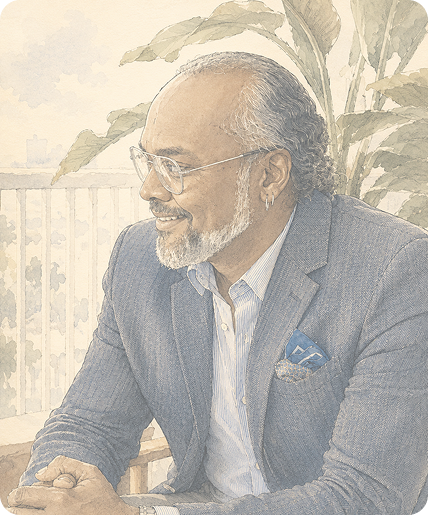
Written by
Jason Inasi
Jason Inasi is a technology entrepreneur, Founder and CEO of DigitalDNA Labs, and Founder and Chief Product Officer of ReadableIQ. For more than 25 years, he has built digital platforms at the intersection of technology, marketing, and artificial intelligence.
About JasonContinue the Conversation
Have thoughts on this? I'd love to hear from you.
Get in touch